
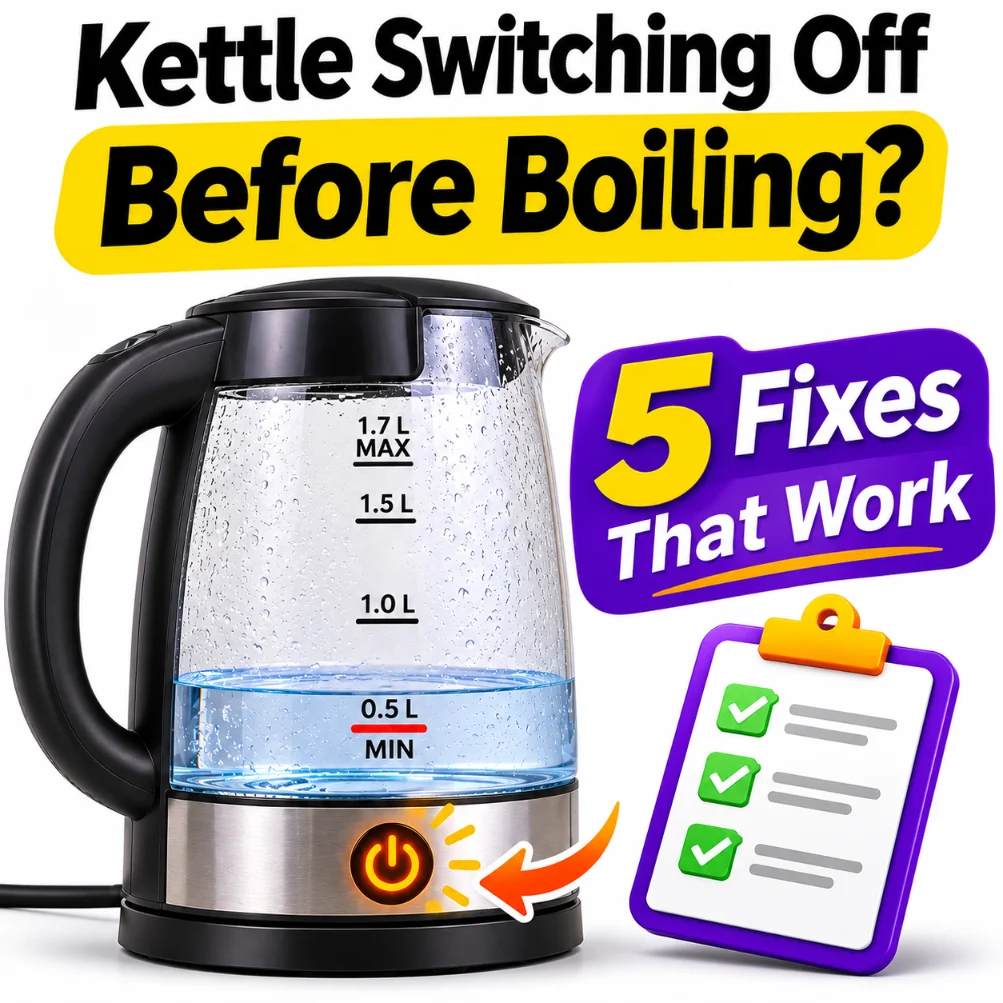
A kettle switching off before boiling is usually caused by low water, a poorly seated base, limescale, or a loose lid. These simple checks solve most cases.
If your kettle keeps turning off after them, it likely has an internal thermostat or switch fault. Replace it or have it checked under warranty.
This guide walks you through each check in order, so you can fix an electric kettle that turns off too early without wasting money on a new one. It also covers South African factors such as hard water and power surges, and your rights if the kettle is faulty.
Quick diagnosis: why your kettle keeps turning off
Match what your kettle does to the most likely cause.
| What you notice | Likely cause | What to do |
|---|---|---|
| It switches off within seconds | Water below the minimum line, or the kettle is not seated properly on its base | Check the water level and reseat the kettle |
| It stops after a short while and the water is only warm | Limescale on the heating element or steam path | Descale the kettle |
| It cuts out at random times, or steam escapes around the lid | Lid not fully closed, worn seal, or blocked steam vent | Check the lid and steam path |
| It switches off by itself during load shedding or when power returns | Unstable power supply or a loose plug connection | Check the plug and socket, and use a surge protector |
| It still cuts out after all the checks above | Worn thermostat, faulty auto-shutoff switch, or heating-element problem | Stop using it and claim under warranty or replace it |
Electric kettles have an automatic shutoff to prevent overheating and reduce fire risk. The kettle cuts power when it senses boiling, or when it detects a condition that resembles overheating.
1. Check the water level (kettle switches off straight away)
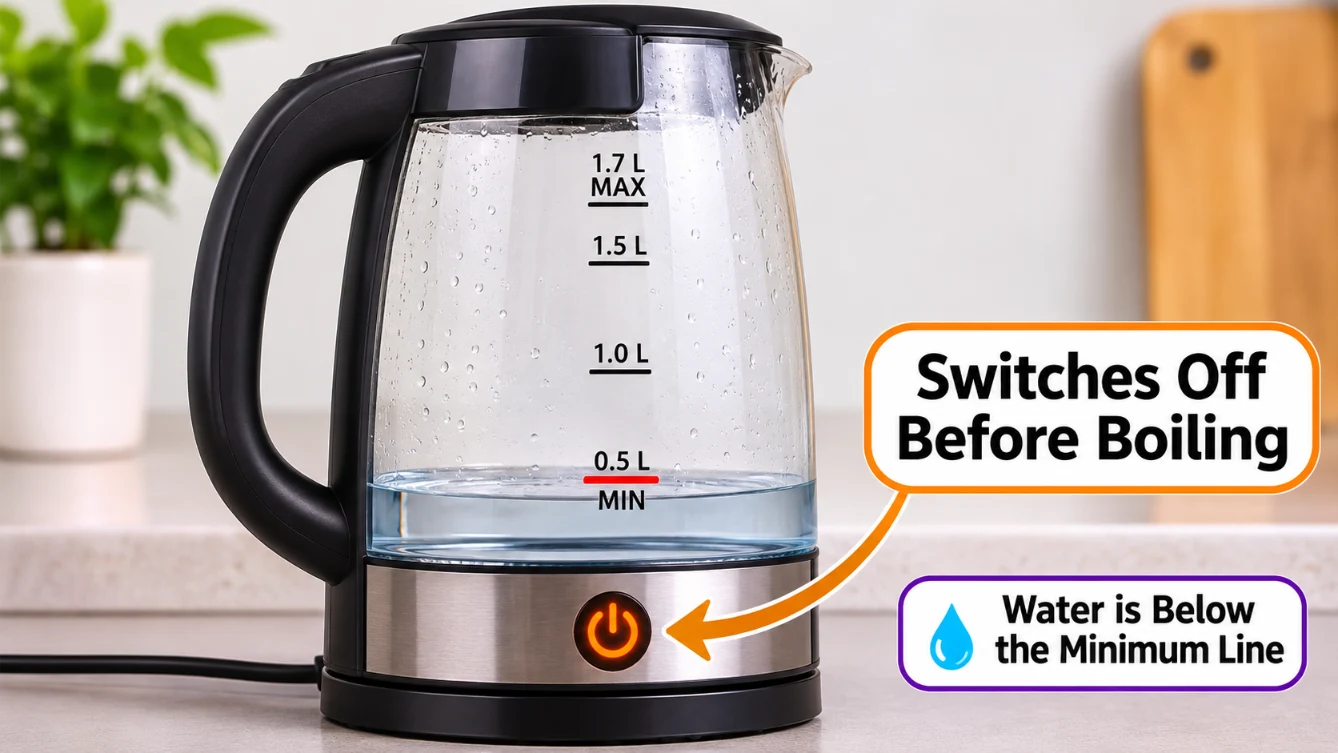
If your kettle switches off within seconds, check the water first. When the water is below the minimum-fill mark, the heating element may not be fully covered. That can trigger the boil-dry or overheat protection.
- Unplug the kettle and let it cool completely.
- Find the MIN line inside the kettle.
- Fill with water to at least that line.
- Place the kettle squarely on its base.
- Switch it on and see whether it reaches a full boil.
Note: Never fill above the MAX line. Overfilling can make boiling water spit or leak.
If it now boils normally, you’re done. If not, move to Fix 2.
2. Reseat the kettle and check the power base
A cordless kettle needs good contact with its power base. Dust, moisture, a loose connection, or an uneven surface can interrupt power. That makes your kettle switch off by itself, even though the shutoff hasn’t triggered.
- Switch off and unplug the base from the wall.
- Inspect the metal contacts on the kettle and on the base.
- Look for limescale flakes, food debris, moisture, burn marks, or discoloration.
- Wipe the contacts gently with a dry cloth only.
- Put the base on a dry, flat, stable surface.
- Press the kettle firmly onto the base and try a different wall socket if you can.
Safety: Never immerse the kettle body or base in water. Don’t use wet cloths, sprays, or liquid cleaners on electrical contacts.
South African tip: load shedding and power surges
Many South African homes deal with load shedding and the surges that can follow when power returns. A loose plug, a worn socket, or an overloaded multiplug can make a kettle cut out mid-boil. Plug the kettle directly into a wall socket, avoid sharing a multiplug with other heavy appliances like heaters or microwaves, and consider a surge protector for your kitchen appliances.
If it now boils normally, you’re done. If not, descale it.
3. Descale the kettle (limescale causes early shutoff)
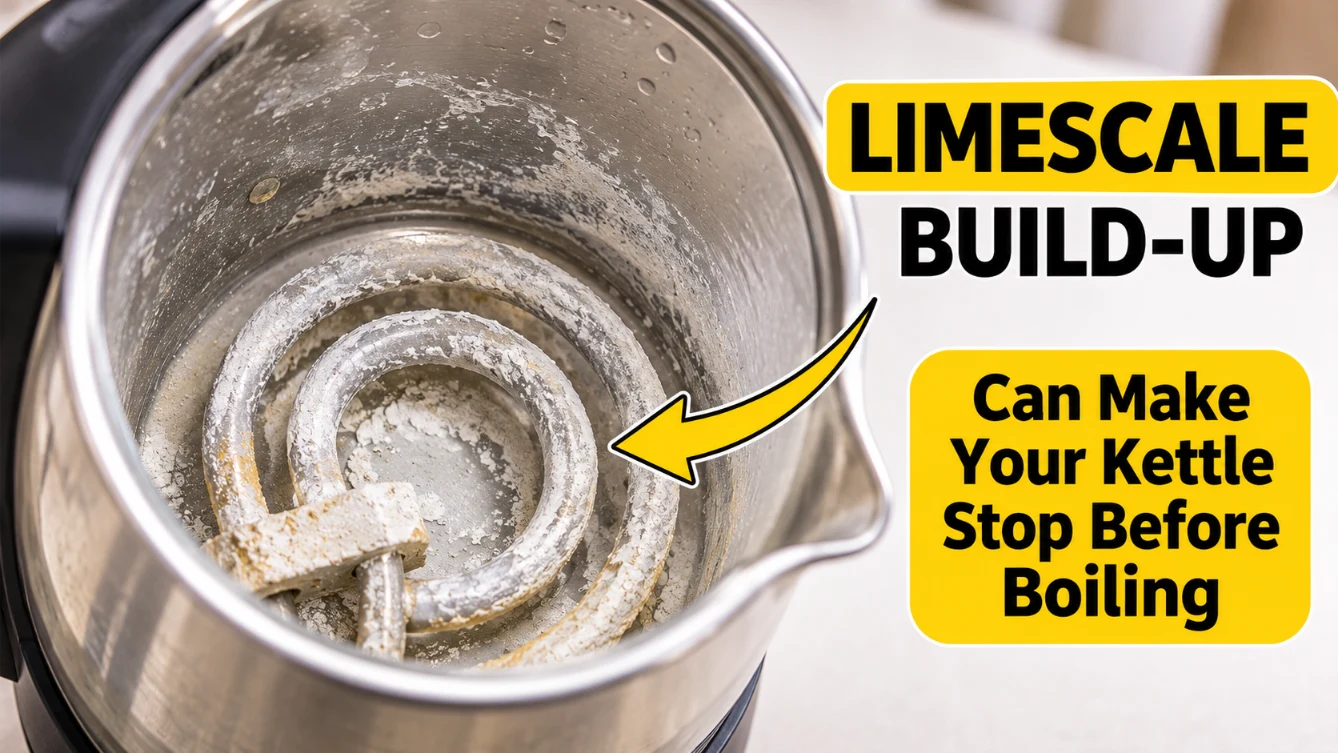
Limescale is one of the most common reasons a kettle stops before boiling. Mineral deposits on the heating element and around the steam path can interfere with how the kettle senses heat and steam.
Water hardness in South Africa varies by region and municipality, and kettles in harder-water areas scale up faster. White, chalky deposits inside the kettle are the giveaway.
- Unplug the kettle and let it cool.
- Check the manual for the manufacturer-approved descaling method.
- Use a kettle descaler or citric-acid descaler exactly as the label directs.
- Don’t boil the descaling solution unless the instructions say to.
- Leave the solution for the time stated on the label.
- Empty the kettle and rinse it several times with fresh water.
- Fill to the minimum line or above and test again.
Electrolux also names heavy limescale at the base of the kettle as a cause of early shutoff. It advises descaling, then rinsing thoroughly with fresh water.
How often should you descale? Descale whenever you see chalky deposits or notice slower heating. Manufacturers commonly suggest every three months. If your area has hard water or you boil several times a day, do it more often.
If it now boils normally, you’re done. If not, check the lid.
4. Check the lid and steam vent
Many kettles rely on steam reaching an internal sensor to trigger the shutoff. A loose lid, a damaged seal, or a blocked steam vent can make the kettle cut out before the water has properly boiled.
- Unplug the kettle and let it cool.
- Remove the lid and inspect it.
- Make sure it closes fully and sits evenly.
- Check the rubber or silicone seal for cracks, flattening, or damage.
- Look around the spout filter and steam vent for limescale flakes or debris.
- Clean removable parts as the manufacturer instructs.
- Close the lid securely and test again.
Some manufacturers state that the kettle must be used with the lid closed and the filter in place. Otherwise it may not shut off correctly.
If it now boils normally, you’re done. If not, the fault is probably internal.
5. Recognise an internal fault (thermostat or switch)
Suppose your kettle still switches off before boiling after the water level, base, limescale, and lid checks. The cause is probably inside the kettle. Typical culprits are a worn bimetallic thermostat, a sticking auto-shutoff switch, or a heating-element problem.
Don’t keep switching it on to see what happens. A consistent early cutoff means the kettle needs professional inspection, warranty support, or replacement.
- Stop using the kettle.
- Check whether it is still under warranty. Keep your proof of purchase.
- Contact the retailer or manufacturer.
- If it is old, damaged, or out of warranty, replace it.
Your rights in South Africa
Under the Consumer Protection Act, you generally have six months from purchase to return goods that turn out to be defective. You can ask for a repair, replacement, or refund. Take the kettle and your receipt back to the store, whether that’s Takealot, Makro, Game, Builders, or a local retailer. Check the product’s own warranty terms as well.
When to stop using your kettle immediately
Stop and arrange a repair or replacement if you notice any of these:
- Damage to the cord, plug, base, or kettle body
- A burning smell or scorch marks
- Tripping the socket or DB board, sparking, or unusual electrical noises
- Water leaking from the base or body
- Repeated early shutoff even after descaling and the basic checks
- A switch that feels loose, jammed, or doesn’t return properly
Don’t open the sealed base or heating compartment yourself. The electrical components inside can be dangerous if mishandled.
What not to do
- Don’t keep pressing the switch while the kettle cuts out.
- Don’t run the kettle empty or below the minimum line.
- Don’t immerse the kettle or its base in water.
- Don’t scrape the element, steam vent, or contacts with metal objects.
- Don’t use harsh abrasives or unknown chemicals inside the kettle.
- Don’t assume descaling will fix every early shutoff.
Quick troubleshooting order
- Fill to at least the minimum line.
- Reseat the kettle firmly on its base.
- Plug it directly into a working wall socket.
- Descale with an approved product.
- Check the lid, seal, and steam vent.
- If it still switches off early, stop using it and claim under warranty or replace it.
Most early shutoffs come down to low water, scale build-up, or poor base contact. If the fault remains after those checks, treat it as an internal safety issue rather than something to force or repair yourself.
[Internal link placeholders: “how to descale a kettle” guide, “best electric kettles in South Africa”, “how to protect appliances from load shedding surges”. Link these three where they fit naturally.]
Frequently asked questions
How does a kettle switch off automatically?
Most electric kettles use a thermostat that reacts to steam. When the water boils, steam travels through a small channel inside the kettle to a sensor, usually a bimetallic strip. The strip is made of two metals that expand at different rates. The steam heats it, so it bends and flips a switch that cuts power to the heating element. That is why the kettle clicks off at a full boil.
Most kettles also have a second, backup protection. If the kettle is switched on with too little water, or the element overheats, a safety cutout turns the power off. This is why low water, limescale, or a blocked steam vent can make a kettle switch off early. The shutoff is triggered by the wrong signal, not because the kettle has boiled.
Can limescale make a kettle switch off early?
Yes. Scale on the heating element and around the steam path changes how heat and steam reach the sensor, so the kettle can shut off before a full boil. Descaling and rinsing thoroughly often fixes it.
Can load shedding damage or switch off my kettle?
Power cuts and the surges when electricity returns can stress appliances and loosen connections. Plug the kettle directly into a wall socket and consider a surge protector. Unplugging heavy appliances during outages is also a good habit.
Kettle not working but the light is on: why?
Power is reaching the kettle but not the element. Dry-wipe the contacts, reseat the kettle, descale it, and check the water level. If the water stays cold after that, the element or thermostat has probably failed.
Why is my kettle leaking from the bottom?
Unplug it and stop using it. The cause is usually a worn seal, limescale damage, or a cracked base. Contact the retailer or manufacturer, or replace it.
Can I use vinegar or citric acid to descale my kettle?
Many people use citric acid, and kettle descalers are widely sold. Check your manual first, because manufacturers differ on approved methods. Follow the product label, don’t boil the solution unless told to, and rinse the kettle several times afterwards.