

Oct 29, 2026 · @Winny
If your washing machine is shaking too much during the spin cycle, banging against the wall or slowly “walking” across the floor, you are not alone. The good news is that most cases come down to an unbalanced load or a machine that is not level, and both take only a few minutes to fix.
This guide takes you through the quick checks first on washing machine shaking too much solution, then the mechanical faults that need a technician, and finally what repairs typically cost in South Africa so you can decide whether to fix or replace.
Quick answer: why your washing machine shakes too much
Most washing machines shake because the load is unbalanced, the machine is not level, the transit bolts are still fitted, or the suspension parts have worn out. Use this table to match what you see to the most likely cause.
| What you notice | Likely cause | First thing to try |
|---|---|---|
| Shakes only with towels, duvets or one bulky item | Unbalanced load | Pause, untangle and spread the load evenly |
| Rocks when you push a corner | Machine not level | Adjust the feet until all four grip the floor |
| New or recently moved machine shakes violently | Transit bolts still fitted | Remove the bolts at the back |
| Shakes only when the drum is packed | Overloading | Take some items out and spin again |
| Bangs or “walks” even with a small, balanced load | Worn shock absorbers or suspension | Stop using it and call a technician |
| Loud rumble or roar during spin | Worn drum bearings | Stop using it and call a technician |
Stop the machine safely first
Before you troubleshoot, put safety first. A washer combines water, a heavy spinning drum and mains electricity.
- Pause or cancel the cycle and wait for the drum to stop completely.
- Do not force a front-loader door open. If there is still water inside, drain it through the drain filter or the machine’s drain cycle first.
- Switch off at the wall and unplug the machine before you pull it out, look behind it or check underneath.
- Keep your hands away from the drum until it has stopped moving.
60-second checklist before you start
Answer these quickly. They point you to the right fix below.
- Does it shake only during the spin cycle, or throughout the wash?
- Does it happen with every load, or only with bedding, towels or jeans?
- Does the machine rock when you push down on a top corner?
- Is it standing on a hard, level floor?
- Is there a loud rumble, grinding or banging noise?
- Did you just buy, install or move the machine?
1. Redistribute an unbalanced load
An unbalanced load is the number one reason a washing machine shakes during spin. One heavy item, a balled-up sheet or a single duvet sits on one side of the drum, and the machine cannot spread the weight as it speeds up.
Pause the cycle, open the door or lid once the drum has stopped, and untangle the laundry. Spread the items around the drum so the weight is even. Then restart the spin.
A simple habit helps: do not wash one bulky item alone. A single wet towel or blanket is far heavier on one side than a mixed load. Add a few lighter items so the machine has something to balance against.
2. Check whether the washing machine is level
A machine that is not level will rock and bang, even with a perfectly balanced load. To test it, stand in front of the machine and push down firmly on each top corner, one diagonal pair at a time. If it rocks, it is not sitting evenly on its feet.
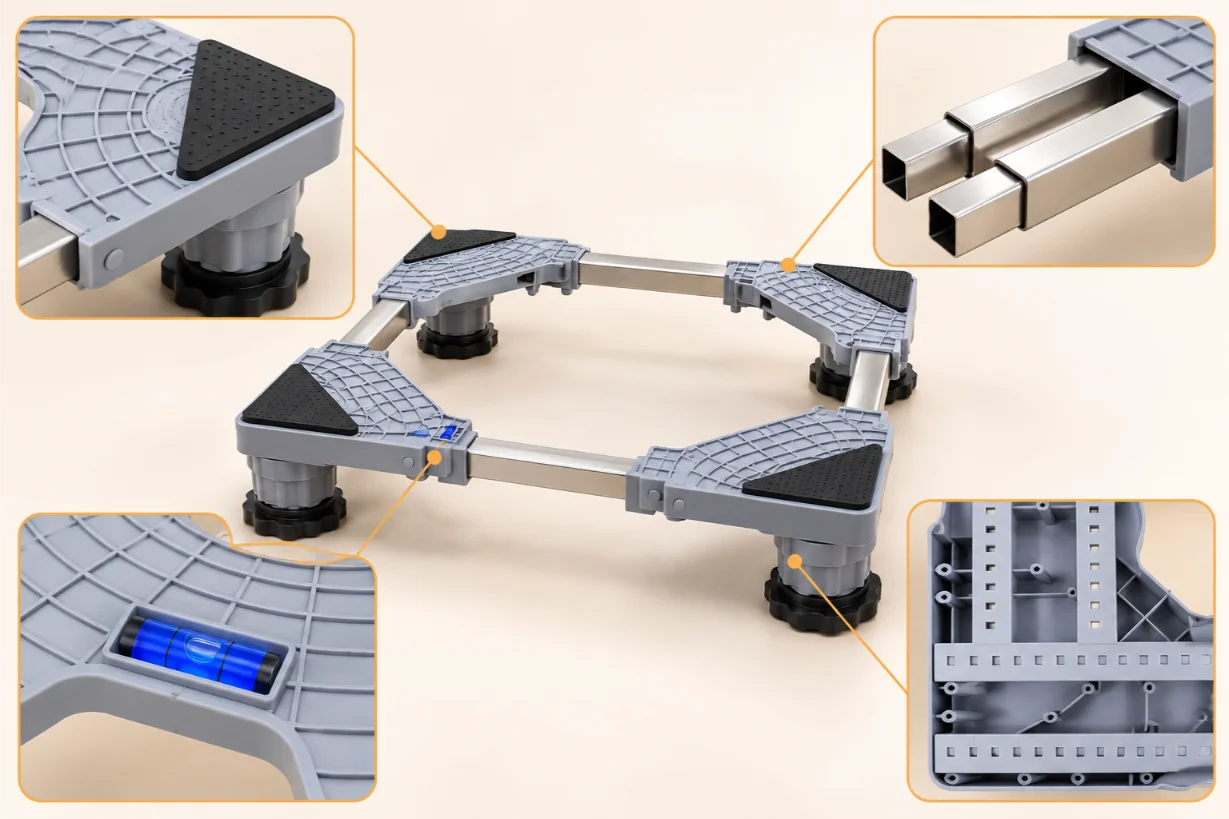
To fix it:
- Place a spirit level (or a level app on your phone) on top of the machine.
- Loosen the lock nut on the foot that is too short.
- Twist the foot up or down until the machine is level and the foot firmly touches the floor.
- Tighten the lock nut against the machine body so the foot cannot drift.
- Push the corners again. There should be no rocking at all.
If you cannot adjust all four feet on your model, level the adjustable ones and check that the machine is stable. Rubber anti-vibration pads under the feet help absorb noise, but they are an extra measure and not a substitute for levelling.
3. Check the floor under the machine
Sometimes the machine is fine and the floor is the problem. Weak timber floors, loose boards, an uneven tiled surface or a machine standing on a raised platform can all magnify vibration.
Many laundries and kitchens in South African homes have tiled floors with a slight slope towards a drain, which makes levelling a little trickier. Take your time with the feet, and check again after the first full spin.
The best spot is a firm, flat surface. If your washer sits on a platform or plinth, make sure it is solid and does not flex when the machine spins. A heavy machine on a springy surface will keep shaking, no matter how well you level it.
4. Remove the transit bolts if the machine is new
If your new or recently moved washing machine shakes violently, check for transit bolts. These bolts hold the drum steady during delivery. If they stay in, the drum cannot move on its suspension, and the whole machine will thump and vibrate.
They are usually at the back, often three or four of them, sometimes with plastic spacers. Unplug the machine, remove them with a spanner, and fit the plastic caps supplied in the box over the holes. Keep the bolts. You will need them if you move the machine again.
5. Check pockets, the drum and the filter for trapped objects
Coins, buttons, hairpins and bra wires can slip out of pockets and clothing and get stuck between the drum and the outer tub. They cause rattling, clanking and sometimes uneven spinning.
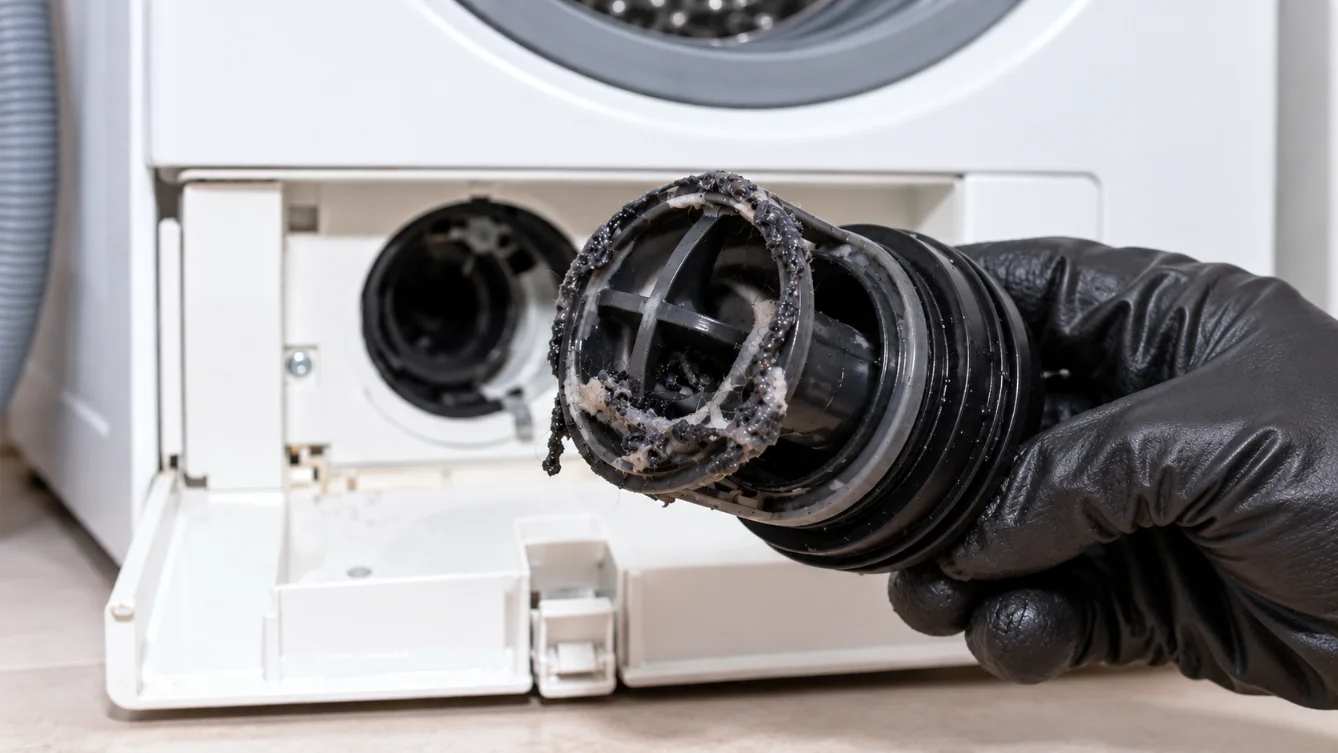
A blocked drain filter does not usually cause shaking on its own, but it is worth cleaning every few weeks, and it is where lost coins and wires often end up:
- Switch off and unplug the machine.
- Place a shallow tray and a towel under the filter access panel.
- Open the panel, drain any water, then unscrew the filter.
- Remove coins, hair, lint and debris, then rinse the filter.
- Screw it back in firmly and close the panel.
Always check pockets before you load, and put underwired bras and small items in a mesh laundry bag.
6. Reduce overloading and spin speed
A drum that is crammed full cannot spread clothes evenly, so the machine goes out of balance quickly. As a guide, you should be able to fit a hand’s width of space above the clothes. Check the load capacity in your manual and stay below it.
For heavy items like duvets, jeans or towels, choose a lower spin speed. The machine will spin more gently, and any imbalance will have less force behind it.
7. Check the suspension rods or shock absorbers
Inside your washer, the drum is held in place by suspension parts that soak up the vibration of every spin. Front-loaders usually rely on shock absorbers (dampers), while top-loaders often use suspension rods and springs. When these wear out, the drum can no longer stay steady, and the machine shakes and bangs even when the load is small and balanced.
Warning signs include:
- Repeated banging that gets worse over time
- The machine “walking” across the floor on every spin
- A drum that bounces or drops easily when you push it with the machine off and empty
This is usually a job for a technician, although confident DIYers can sometimes replace the parts themselves. Dampers should be replaced as a set so the drum stays balanced.
8. Listen for worn drum bearings
Worn drum bearings have one signature sound: a rumble or roar that grows louder as the drum speeds up, a bit like a distant aeroplane. You may also notice that the drum has play when you hold it and wiggle it with the machine off.
Bearings wear gradually. Left too long, they can damage the drum or tub and turn a repair into a replacement. Because the job is labour-intensive and often involves taking the machine apart, get a professional diagnosis rather than trying it yourself.
9. Look for loose counterweights or internal parts
If you hear one heavy knock for each turn of the drum, a loose counterweight or an object trapped between the drum and the tub could be the cause. Counterweights are the heavy blocks fitted to the tub to steady it during spin.
Stop using the machine and call a technician. Running it with a loose counterweight can crack the tub and make the repair far more expensive.
Front-loader vs top-loader shaking
The basic fixes are the same for both types, but the parts that wear out differ.
| Front-loader | Top-loader | |
|---|---|---|
| First fixes to try | Redistribute the load, level the feet | Redistribute the load, avoid overloading |
| Parts most likely at fault | Shock absorbers, bearings, counterweights | Suspension rods and springs, worn pads |
| Typical warning sound | Rumble, banging, play in the drum | Thumping, rocking, a drum that sags to one side |
| Next step if shaking continues | Call a technician | Call a technician |
When to call a washing machine technician
Stop using the machine and book a technician if:

- The shaking continues after you have levelled the machine and redistributed the load
- The machine walks across the floor even with a small, balanced load
- You hear grinding, roaring or metal-on-metal noises
- The drum clunks or has noticeable movement when you wiggle it
- You suspect worn shock absorbers, suspension rods or bearings
Keeping a badly shaking machine running can damage the hoses, the flooring and the machine itself, so do not leave it for weeks.
Washing machine repair costs in South Africa
Most washing machine repairs in South Africa cost between R650 and R3,500, depending on the fault, the parts and the call-out fee. These figures come from published 2025 and 2026 price guides by repair companies, and they will vary by area and brand. Use them as a guide and always ask for an itemised quote.
| Repair or fee | Typical price |
|---|---|
| Service call-out fee | R350 – R650 |
| Noise-related repairs | R950 – R2,500 |
| Shock absorber replacement (front-loader) | R1,200 – R2,400 |
| Bearing assembly replacement (front-loader) | R2,200 – R4,200 |
| Typical overall repair range | R650 – R3,500 |
Prices above are indicative and come from Van Biljoens, a Pretoria repairer (July 2026), and Kandua’s cost guide. Rates in other cities may differ, and premium brands can cost 30 to 50% more for parts.
Repair or replace?
A common rule of thumb is that if a repair costs more than half the price of a comparable new machine, replacement usually makes more sense. Age matters too:
- Under five years old: repairing is almost always the better choice
- Around 8 to 12 years old: most washers are near the end of their life, so weigh a bearing quote carefully
- Multiple faults at once, or a repeat of the same fault: a new machine is often the smarter spend
For example, a R3,500 bearing job on an old machine that costs R5,000 to replace is hard to justify. The same quote on a three-year-old premium washer probably is.
Washing Machine Shaking Too Much FAQs
Why is my washing machine shaking violently during the spin cycle?
Usually an unbalanced load or a machine that is not level. If it keeps shaking with a small, balanced load on a level floor, the shock absorbers or suspension may be worn.
Can an unbalanced load damage my washing machine?
Occasional imbalance is normal and most modern machines cope with it. Repeated violent shaking puts extra strain on the suspension, bearings and hoses over time.
How do I stop my washing machine moving across the floor?
Level all four feet so they touch the floor firmly, redistribute the load and avoid overloading. Anti-vibration pads can help on smooth tiles.
Why does my new washing machine shake so much?
Check for transit bolts at the back first. Then check the levelling and make sure the first load is not too heavy or lopsided.
Is it worth repairing a washing machine with worn bearings?
It depends on the age of the machine and the quote. One Pretoria repairer lists bearing assembly replacement at R2,200 to R4,200, so compare the quote with the price of a new machine using the 50% rule above.
Is it safe to keep using a washing machine that shakes badly?
Not for long. If it is banging hard, moving across the floor or making grinding noises, stop using it until it has been checked.