
Last updated: 6 October 2026. Prices and offers change often, so check them before you buy.
By Winny. I research every appliance carefully and explain it in plain words, so your kitchen looks good and works well.
A fridge, stove or washing machine is a big spend. You also pay to run it every month. So the lowest price on the shelf is not always the cheapest choice.
This kitchen appliances buying guide helps you pick the right size, the right type and a fair price. It uses South African prices, rules and power costs. Where a number comes from a brand, we say so. Brand numbers show the best case, so treat them as a guide.
Short on time? Use this 5-step checklist
- Measure your space. Include the path the appliance must take to get into your home.
- Set your budget. Count the purchase price and the yearly running cost.
- Match the size to your household. Too big wastes power. Too small means extra loads.
- Check the energy label and plan for power cuts.
- Check the warranty, the service centres and real reviews before you pay.
1. Measure your space first
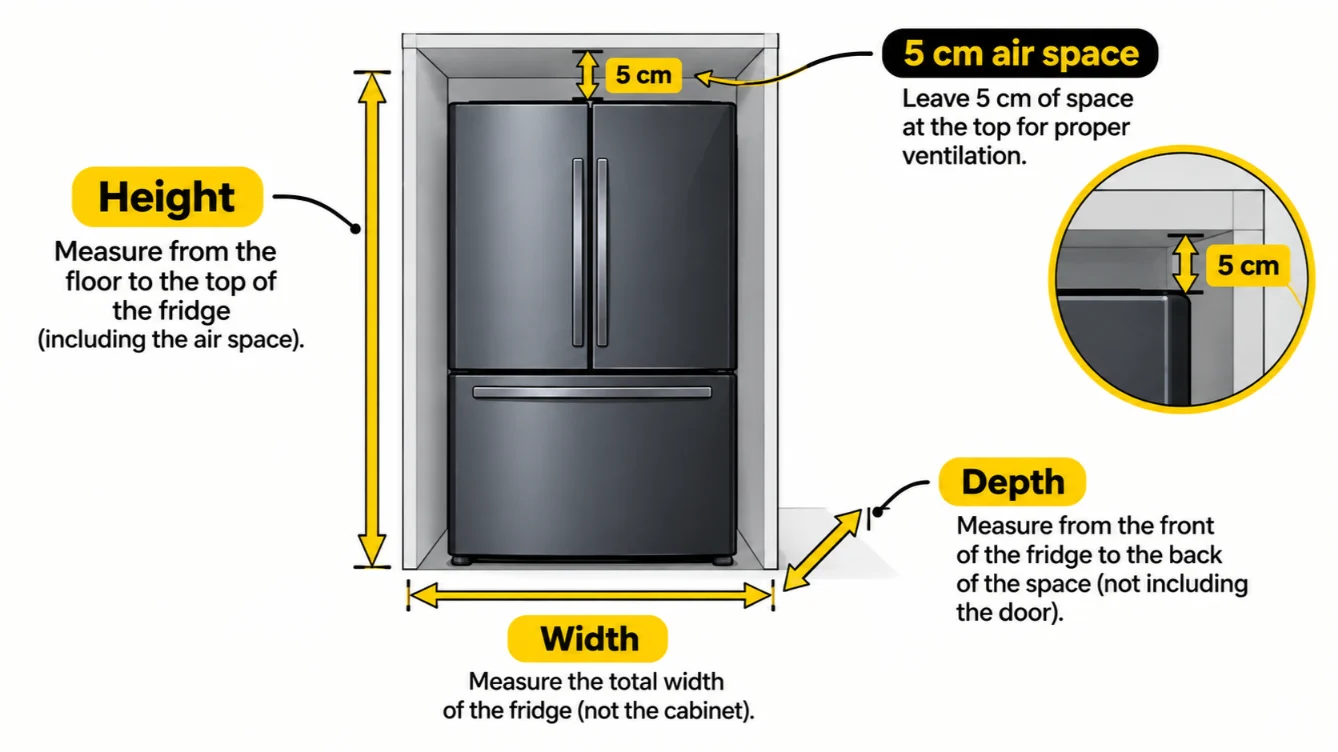
Measure the height, width and depth of the gap where the appliance will stand. Then measure the way in: doorways, gates, stairs and tight corners. Check which way doors will swing open.
A few size facts from South African brands:
- Fridges need air around them. Defy says to leave at least 5 cm above and behind the fridge. Other brands may say something different, so read the manual for your exact model.
- Most washing machines fit a 60 cm wide gap, according to Beko. Depth grows with capacity. Samsung says medium machines (8 to 10 kg) are about 550 to 600 mm deep, and large machines (11 to 12 kg) are about 600 to 650 mm deep.
- Freestanding cookers (a hob and an oven in one unit) come in 60 cm and 90 cm widths.
- Check your plug points, water points and gas point. A gas cylinder must sit a set distance from doors, windows, drains and power plugs. Your registered gas installer will tell you the exact distances.
Tip: Write your measurements in your phone and take a tape measure to the shop. Compare against the product’s full dimensions, not just its capacity.
2. Set your budget
Every appliance has two costs:
- The purchase price, which you pay once.
- The running cost, which you pay every month on your electricity bill (and sometimes water or gas).
Fridges and freezers run all day and night. Defy points out that this makes their energy use a big part of your bill. This is why it pays to look at the energy label on a fridge, not only the price.
Example prices
These are real listings we found while researching in October 2026. They show the spread of prices. Prices move, so check before you buy.
| Appliance | Example | Price |
|---|---|---|
| Chest freezer | Hisense 97 L | R2,799.99 |
| Fridge-freezer | Hisense 263 L combi | R5,999.99 |
| Fridge-freezer | Bosch bottom-freezer combi (KGW36NL2AZ) | R8,299.99 |
| Side-by-side fridge | Hisense 506 L | R14,999.99 |
| Side-by-side fridge | Haier 585 L | R17,999.99 |
| Large fridge-freezer | Bosch 619 L (KGN86CI30Z) | R23,999.99 |
| Microwave (grill) | Defy 34 L | R2,399 |
| Microwave (convection) | Defy 43 L | R4,599.99 |
Fridge prices come from Hirsch’s listings on PriceCheck. The microwave prices come from Binuns and Hirsch’s.
Defy published these washing machine prices in early 2025. Defy said they were correct at the time of writing, so they may have changed:
| Washing machine | Price |
|---|---|
| 6 kg front loader | R4,999 |
| 7 kg front loader | R5,999 |
| 9 kg front loader (SteamCure) | R7,999 |
| 8 kg top loader | R5,999 |
| 14 kg top loader | R6,999 |
| 17 kg top loader | R8,999 |
For stoves, dishwashers and tumble dryers, prices vary a lot by type and size. Compare at least three retailers.
Smart ways to pay less
- Compare prices across shops. PriceCheck is a price-comparison site. It showed one Bosch fridge listed between R8,299.99 and R10,599, a gap of over R2,000 for the same model.
- Watch the sales. Black Friday falls on 27 November 2026. Look at prices a few weeks before, so you know what a normal price is.
- Be careful with credit. A shop may show a low monthly amount. Always ask for the total you will repay, including interest and fees.
- Used appliances are sold on sites like Gumtree. Ask for the original invoice, see the appliance working, and ask whether any warranty is left. The six-month right described in section 8 applies when you buy from a business. If you buy from a private seller, ask whether any protection applies. Do not assume it does.
3. Match appliances to your household
Buy for the people you feed and the laundry you wash. Bigger is not always better. A big fridge costs more to run, and a big washing machine uses more water per full load.
Fridge size (litres)
Defy gives this starting rule: 100 litres per adult plus 50 litres per child. Then adjust for how you shop.
| People in your home | Fridge-freezer size |
|---|---|
| 1 person | 100 to 150 L |
| 2 people | 200 to 250 L |
| 3 to 4 people | 300 to 350 L |
| 5 or more | 400 to 500+ L |
- For a family of four, Defy says 300 to 400 L is the most practical range.
- If you shop once a week or buy in bulk, go to the higher end. If you shop every two or three days, the lower end works.
- Children and teenagers use more space. Add 30 to 50 L if yours eat a lot of dairy, fruit or packed lunches.
- Compare net capacity (the space you can actually use). Gross capacity is the total inside volume before the shelves and parts are taken out.
Washing machine size (kilograms)
Washing machine size is the weight of dry clothes it can hold in one load.
- Defy suggests about 1.5 kg of drum space per person.
- Defy says 7 to 9 kg covers most South African families. Both Defy and Beko say a family of four usually does best with 8 or 9 kg.
- Beko says you need 9 kg or more to wash queen or king size duvets at home.
- Large families, or people who wash heavy bedding often, can look at 10 to 12 kg.
Cooking habits
- If you bake, cook big pots or host often, oven size matters. As examples, a Defy 90 cm gas/electric cooker has a 102 L oven, and a Smeg 90 cm cooker has a 115 L (net) oven.
- With young children, supervise them around the stove. On a gas hob, look for a flame failure device. It cuts the gas if the flame goes out.
4. Power, running costs and energy labels
This is where many buyers lose money. Read this section before you pick a model.
What the South African energy label tells you
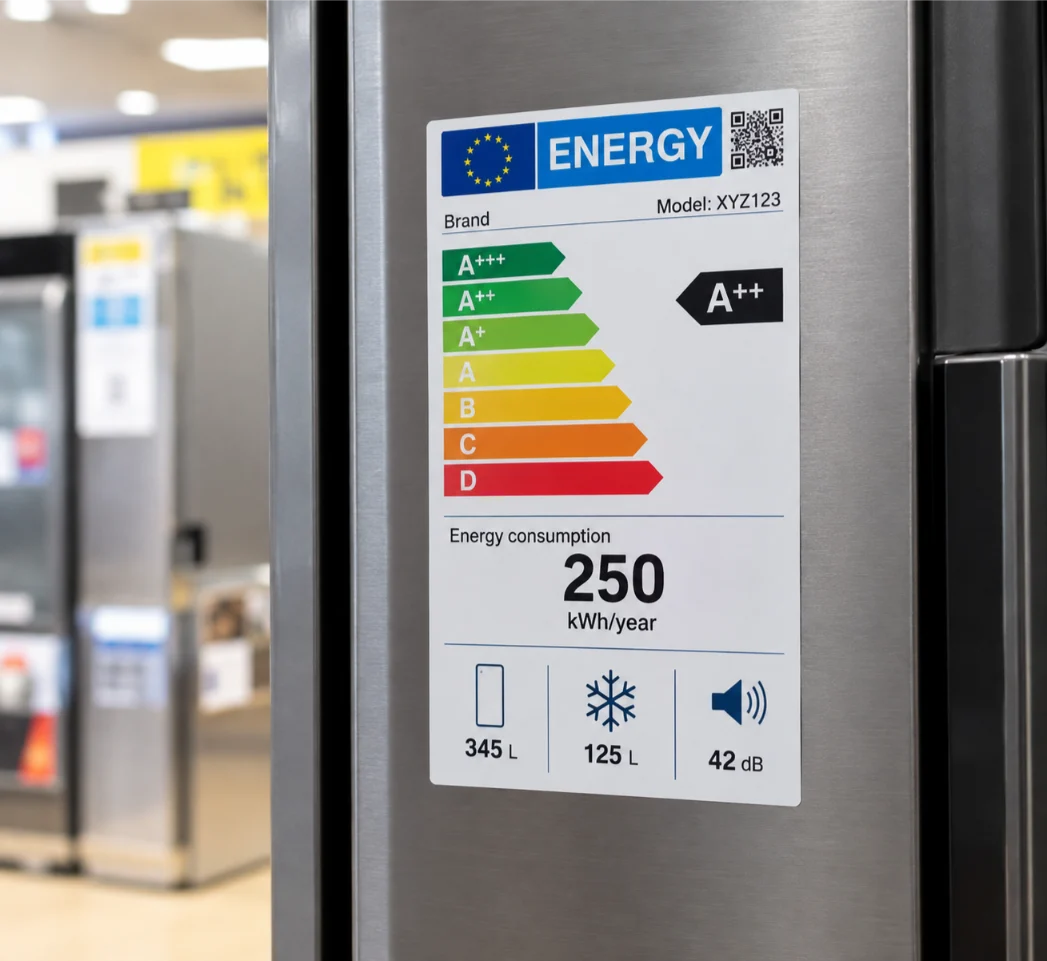
In South Africa, certain appliances must carry an energy efficiency label. The rule is called SANS 941 (a South African National Standard). It covers fridges, freezers, washing machines, washer-dryers, tumble dryers, dishwashers and electric ovens.
The label shows:
- The appliance type and model.
- An energy class. For fridges, the scale runs from A+++ (best) down to D (worst).
- The kWh per year. A kWh (kilowatt-hour) is one unit of electricity, the same unit on your electricity bill.
- The SANS number and the South African energy efficiency logo.
Compare labels only between the same type of appliance. A fridge’s class can’t be compared with a washing machine’s class.
Fridges also have a climate class: SN, N, ST or T. It tells you the room temperatures the fridge is made for. Pick one that suits your kitchen.
The label covers electricity use only. It says nothing about gas.
How to work out the yearly running cost
Yearly cost = kWh per year (on the label) × your price per kWh (on your bill)
Example, only to show the sum: if your price is R3.00 per kWh and a fridge uses 300 kWh a year, it costs about R900 a year to run. Use your own rate. If you buy prepaid electricity, check the rate on your last purchase.
For scale, Defy says a small fridge (100 to 150 L) uses about 150 to 250 kWh a year. A medium fridge (150 to 250 L) uses about 250 to 400 kWh a year. A better energy class can make a bigger fridge cheaper to run than a smaller, less efficient one.
Electricity is getting more expensive
The regulator, Nersa, approved these average increases for 2026/27:
- 8.76% for customers who buy directly from Eskom, from 1 April 2026.
- 9.01% for municipalities that buy from Eskom, from 1 July 2026. Your own municipality sets its final tariff, so check your bill.
- A further 8.83% for direct Eskom customers is approved from 1 April 2027.
This means an efficient appliance saves you more each year.
Load shedding and load reduction
- Load shedding is planned, national power cuts when Eskom does not have enough supply.
- Load reduction is local. Eskom cuts power to overloaded areas to protect equipment. It is not the same thing.
Eskom’s winter outlook said no load shedding was expected from 1 April to 31 August 2026. Reports say South Africa has had no load shedding since 16 May 2025. By mid-September 2026, one energy site counted more than 470 days. Load reduction still affects parts of Gauteng and KwaZulu-Natal, usually in the early morning and evening. Eskom says it plans to end load reduction in seven provinces by October 2026, with Gauteng and KwaZulu-Natal to follow in 2027.
Things can change, so check Eskom’s website for the latest. Many people still plan for power cuts when they pick appliances.
Keeping food safe in a power cut
The most important rule: keep the fridge and freezer doors shut.
A South African municipal guide says:
- A closed fridge keeps food cold for about 4 hours.
- A full freezer keeps food frozen for about 48 hours. A half-full one lasts about 24 hours.
- If power will be out longer than 4 hours, buy block ice for the fridge.
Manufacturers give their own, usually shorter, numbers. Beko, for example, says its freezers hold food frozen for 10 to 18 hours. Your manual lists the figure for your model, so use that as your safe guide.
An unfilled freezer loses cold faster. Defy also says a half-empty fridge uses more power than a full one.
Gas, electric or induction?
- Gas hob: burns LPG (liquefied petroleum gas, the gas in cylinders) and works in a power cut.
- Electric hob: either solid plates or a ceramic glass top. It needs power.
- Induction hob: heats the pot itself, not the hob surface. It needs power. Check your manual for which pots work on induction.
- Hybrid cooker: a gas hob with an electric oven. The hob works in a power cut, but the oven does not.
Is gas cheaper? Opinions differ. One South African energy site (Energybee) estimates LPG at about R38 to R45 per kg in 2026. It concludes that gas is not much cheaper than a modern electric hob, and that induction is usually the cheapest per unit of heat. Treat this as one view. Do your own sum with your gas price and your electricity rate. The main benefit of gas is that you can still cook when the power is off.
Gas safety rules in South Africa
- Every home gas installation must have a Certificate of Conformity (CoC). It confirms the installation was inspected and is safe and leak-free.
- It must come from an installer registered with LPGSA (the LP Gas Safety Association of Southern Africa).
- The homeowner must hold the certificate, not the installer.
- Without the certificate, an insurer can refuse a claim if a gas appliance causes damage.
- This applies to gas stoves and ovens, gas fires and braais, and gas hot water systems.
- Buy gas only from a qualified gas dealer. The appliance should carry SABS and LPGSA approval.
- Get a registered installer to service the system every year.
- If you smell gas, turn the appliance off. Open windows and doors. Do not touch the appliance until a registered gas engineer has checked it.
5. Appliance by appliance
Fridges and freezers
Types of fridge-freezer
- Top-mount (freezer on top): Defy says these tend to give good storage at a lower price.
- Bottom-mount (freezer underneath): puts the fridge at eye level, so fresh food is easier to reach.
- Side-by-side and French door: suit larger kitchens and homes that use the freezer a lot. Defy says they typically start at about 450 L.
Frost-free means ice does not build up, so you never defrost by hand. It is handy, but not a must. Defy describes one non-frost-free A+ fridge-freezer as good value with low running costs.
Inverter compressor. The compressor is the pump that makes the cold. An inverter compressor changes speed instead of switching fully on and off. Samsung says this saves power. One Samsung model on a retailer’s site claims 20% less energy than conventional fridges. That is a brand claim. The kWh figure on the label is the fair way to compare.
Freezers. A chest freezer opens from the top. An upright freezer opens from the front, like a fridge. Either way, a full freezer holds cold longer in a power cut (see section 4).
Keep it running well (advice from Defy):
- Do not put hot food in the fridge. It pushes the temperature up.
- Keep the fridge at about 2 to 4°C. Above 4°C, food will not stay fresh. Keep the freezer at about -17°C or colder.
- Keep it away from the oven and direct sunlight.
- Do not overfill it, because air must flow. Do not leave it half empty either.
Stoves, hobs and ovens
- Freestanding cooker: the hob and oven are in one unit. You slot it in and connect it.
- Built-in set: a separate oven and hob built into your cupboards. Defy sells built-in ovens, hobs, hoods and sets.
- Hob types: solid plate, glass top (ceramic), gas and induction. Section 4 explains the power and gas side of each.
- Thermofan oven: a fan moves hot air around so the heat is even. Defy calls this fan-assisted cooking.
- Multifunction oven: has several modes, such as bake, grill and roast.
- Hybrid cookers: a Hirsch’s blog on a Defy 90 cm gas/electric model points out that you can switch to the electric plates if the gas runs out mid-cook.
- Safety: look for a flame failure device on gas hobs. Supervise children near any stove.
- Hoods and extractors pull steam and smells out of the kitchen. Check the installation manual for how high the hood must sit above your hob.
Microwaves
- Solo: heats, defrosts and cooks. Fine if that is all you need.
- Grill: a solo microwave plus a grill element, for browning and crisping.
- Combi or convection: adds a fan oven, so it can also bake and roast. Useful as a second oven.
Size. One European retailer guide suggests about 20 L for one or two people, and 23 to 25 L or more for families. Defy sells larger models in South Africa, such as 34 L and 43 L.
Power. Higher watts cook faster. Defy’s 34 L grill microwave is 1,000 W. Its 43 L convection model has 1,500 W of microwave power. Both come with a 2-year warranty.
Dishwashers
A place setting is one person’s dishes for a meal: a plate, bowls, a cup and saucer, a glass and cutlery. A standard dishwasher holds about 14 place settings, according to PriceCheck. Defy sells 13 and 15 place models.
Pick the right size. A machine that is too big never gets filled. One that is too small cannot keep up.
Does a dishwasher save water? The numbers below come from brands and consumer sites, so treat them as best-case figures:
- Defy says its 13 and 15 place models use 11.4 to 12.9 L per cycle.
- Bosch says its machines can use as little as 6.5 L per cycle. A 2018 South African media report quoted Bosch putting hand washing of 13 place settings at about 68.5 L on average.
- Cleanipedia says an average dishwasher uses about 15 L per load, and that studies show hand washing can use more water and energy.
- Defy says a dishwasher can use up to five times less water than hand washing, but only if you do not pre-rinse.
Tips: use the eco programme, run full loads and skip the pre-rinse. In hard water areas, Bosch says to use rinse aid, or you may get white marks on glasses.
Noise is shown in dB (decibels). A lower number is quieter. PriceCheck says around 43 dB(A) is a low rating.
Washing machines
Defy compares the two types like this:
| Front loader | Top loader | |
|---|---|---|
| Water and detergent | Uses less of both | Uses more water |
| Cleaning and clothes | Strong on stains, gentler on fabric | Agitator can be rougher on clothes |
| Spin | Often a faster spin, so clothes need less drying time | |
| Capacity | Defy’s front loaders go up to 9 kg | Defy’s go up to 14 and 17 kg |
| Convenience | Door locks once the cycle starts | You can add forgotten items mid-cycle, and it is easier on the back |
| Care | Wipe the door seal and leave the door open between washes to stop mould and smells | Less likely to build up mould |
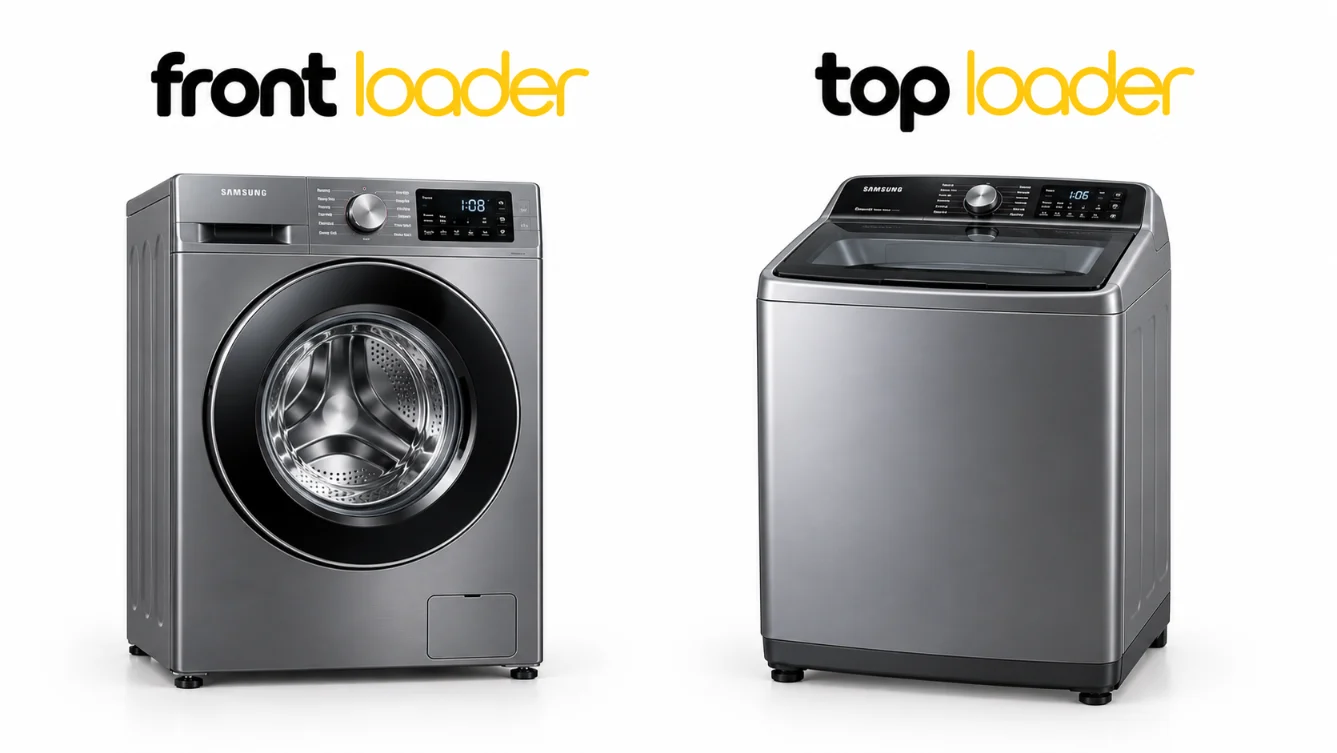
In Defy’s examples, a top loader cost about R1,000 more than a front loader of similar price range. That is Defy’s own comparison of its models.
Tumble dryers
There are three types:
- Vented: blows warm, damp air out through a hose to the outside. Cheapest to buy. Needs an outside wall or vent.
- Condenser: collects the water in a tank (or drains it). No vent needed, so it can go almost anywhere. Costs more to buy than a vented dryer.
- Heat pump: recycles the warm air instead of making fresh heat each time. Most expensive to buy, cheapest to run, and uses lower temperatures, which is gentler on clothes. It dries more slowly.
A correction to common retailer advice: some guides say condenser dryers are the most expensive. Several sources we checked say the heat pump is the priciest to buy, with the condenser in the middle.
Running costs. Which?, a UK consumer group, tested dryers and found heat pump models cost about £54 a year to run, against about £138 to £140 for condenser and vented models. That is roughly 60% less. These are UK figures, so the rand amounts will differ, but the pattern is the same. Defy (South Africa) says the running-cost gap between vented and condenser dryers is modest for most homes. It adds that vented dryers stay popular here because they are affordable and suit homes with a garage or laundry area where venting is easy. Defy sells all three types.
Do you need one? One South African consumer article advises tumble drying only when you must, and for as short a time as possible. A high spin speed on your washing machine cuts drying time. Clean or replace the filters often (Hirsch’s advice).
6. Brands, warranties and after-sales service
Brands you will see in South African shops include Defy, Samsung, LG, Bosch, Siemens, Hisense, Haier, Beko and Smeg. A Hirsch’s blog describes Defy as South Africa’s largest maker and distributor of large home appliances. Defy says its parent company is Beko.
We do not rank brands in this guide. We found no independent South African test results or large owner surveys to base a ranking on. A brand’s own claims are not proof of lasting quality. Compare these things instead:
- Local service. Can you find a service centre near you? Defy, for example, lists service centres and user manuals on its website and lets you register your warranty online. Ask any brand how repairs and spare parts work.
- Warranty length and what it covers. Read the fine print. See the examples below.
- Repeated problems in reviews of the exact model (see section 7).
Warranty examples:
- Defy says its DAC840 fridge-freezer has a 10-year warranty on the compressor.
- Samsung’s South African support page says its fridges have a 2-year warranty, and the inverter compressor has a 10-year warranty that covers the compressor only, not labour. In February 2023, Samsung South Africa announced a 20-year warranty on its digital inverter motors and compressors on selected fridges and washing machines. It covers that one part, not the whole appliance. Check the terms for your model.
- Defy’s microwaves we found are covered for 2 years.
A long warranty on one part is useful, but it does not cover the whole appliance. Do not treat warranty length as the same thing as lifespan.
Extended warranties and service plans. Ask what they cover, what they cost, and what you already get from the maker’s warranty and from the law (section 8). Get the terms in writing.
How to check reviews properly
Always search for the exact model number, not just the brand. One brand can make good and poor models.
- Hellopeter is a South African review site that scores companies. It ranks businesses by a score called TrustIndex, and a business must reply to reviews to rank. Its appliance pages track themes such as product quality, delivery, returns and warranty and repairs. Hellopeter’s own analysis says that in electronics retail, online order delivery and the returns process are the weakest areas. Remember that Hellopeter reviews are mostly about the company, so use them to judge the shop and the brand’s service.
- Retailer product pages. Read the 1, 2 and 3-star reviews of your model. Look for the same fault mentioned by different people.
- Facebook groups. Ask real owners. Try: Has anyone owned the [model number] for more than two years? Did it have any faults? How was the repair service?
- TikTok, Instagram and YouTube. These are good for seeing how an appliance looks and works. Most videos show the first days of use, not years of use. Check whether the post says the product was sponsored or gifted.
- Trustpilot and Google reviews. Check how many reviews there are and how recent they are.
What to look for: faults that appear after 12 to 24 months, how the company handled repairs, and complaints about delivery or installation.
Warning signs: many glowing reviews posted in a few days, reviews with no detail, and a seller who deletes or ignores bad reviews.
Where to buy, and your rights
Before you pay, ask:
- What are the delivery and installation costs?
- Will they take away your old appliance?
- How long will delivery take? PriceCheck says most South African online stores deliver in 2 to 7 business days.
- Who handles repairs, the shop or the brand?
Check at delivery. Look for dents, scratches and missing parts. Check that the model number matches your invoice. Test the appliance if you can.
Be careful of: prices far below every other store, shops with no physical address or phone number, and requests to pay into a personal bank account. Check the shop on Hellopeter first.
Your rights under the Consumer Protection Act (CPA)
This is general information, not legal advice.
- Section 56 gives you a right to return faulty goods within six months of delivery, at no penalty and at the supplier’s risk and expense.
- The supplier must, at your choice, repair, replace or refund. The National Consumer Commission (NCC) says the consumer picks the remedy, so a shop cannot insist on a repair when you asked for a refund.
- If a supplier repairs an item and, within three months, the fault is not fixed or a new fault appears, the supplier must replace it or refund you.
- This is about faults in the product. It does not cover damage you caused.
- Some retailers state the CPA’s six-month period as the minimum warranty on their product pages. Keep your invoice.
If a shop will not help, you can complain to the National Consumer Commission (thencc.org.za).
Set-up and care
- Read the manual before you switch the appliance on. It lists the set-up steps, clearances and power needs for your model.
- Register your warranty if the brand offers it online.
- Gas: use a registered installer, keep your CoC safe and book a yearly service (section 4).
- Clean the filters on tumble dryers, washing machines and dishwashers. Hirsch’s advises replacing them when needed.
- Front-loader seals: wipe them and leave the door open between washes.
- Fridges: keep the vents clear and the door seals clean.
Quick picks by situation
| Your situation | What to focus on |
|---|---|
| Small kitchen or flat | Measure carefully. Choose a fridge of 100 to 250 L for one or two people. If you have no outside vent for a dryer, look at condenser or heat pump types. |
| Large family | A 400 to 500+ L fridge-freezer. A 9 to 12 kg washing machine, or a top loader if you wash very large loads. A 15 place dishwasher. |
| Power cuts | A gas hob (with a gas CoC) for cooking. A full freezer. Check the hold time in the manual. |
| Tight budget | Size appliances to your real needs. Put effort into the fridge’s energy label. Compare three retailers. Avoid credit unless you know the total cost. |
| Renters | Gas installations need a certificate that the homeowner must hold, so ask your landlord first. Freestanding appliances are easier to take with you. |
Kitchen Appliances Buying Guide FAQs
How much should I budget for kitchen appliances in South Africa?
There is no single number, because it depends on size and type. The fridge-freezers we listed in October 2026 ranged from about R6,000 to about R24,000. Add your stove, washing machine and other items, and compare running costs as well as prices.
Is gas or electric better during load shedding?
A gas hob works when the power is off. An electric oven does not. National load shedding has been suspended since May 2025, but some areas still have load reduction.
Is an induction hob worth it?
One South African energy site says induction is usually as cheap as gas or cheaper per unit of heat. You need compatible pots, and the hob needs electricity.
What fridge size do I need for a family of four?
Defy says 300 to 400 L is the most practical range.
What is the best energy rating?
For fridges, A+++ is the best on the South African label and D is the worst. Compare only within the same appliance type.
How long do kitchen appliances last?
We found no reliable independent South African figure, so we do not give one. Warranty length is not the same as lifespan.
Are extended warranties worth it?
Compare what they cover with the maker’s warranty and your CPA rights. Ask for the total cost and the terms in writing.
Is a heat pump tumble dryer worth the extra cost?
It costs more to buy but less to run, and it is gentler on clothes. It makes the most sense if you dry clothes often.
Do dishwashers use less water than hand washing?
Brand and consumer-site figures say yes, if you run full loads and skip the pre-rinse. These are best-case numbers.
Can I run a fridge on an inverter?
Ask a qualified installer to size the system. Your fridge’s manual lists its power use in watts.
How do I know a brand is reliable?
Look at local service centres, warranty terms and repeated problems in reviews of your exact model. Marketing claims alone are not proof.