

If I’m being honest with you, one of the biggest things that quietly consumes a lot of electricity in most homes is your fridge. It runs 24/7, never taking a break, and in this tough economy, every unit of power counts.
Living expenses are through the roof right now, and with the way things are, we’re all trying to cut costs wherever we can.
Electricity is one of those silent killers on our monthly bills, so the smartest move is to look for appliances that actually help us save power instead of adding to the headache.
The best place to start is by choosing a high-quality refrigerator that doesn’t just look good in your kitchen, but one that serves you reliably for many years while keeping fridge power consumption low. That’s exactly why I put together this guide.
In this article, we’re going to look at several popular refrigerator brands in South Africa, compare their energy-saving performance, check their prices, and see what each company brings to the table.
By the end, you’ll have clear, practical information to help you make the right choice and finally get yourself an energy-efficient fridge that won’t keep draining your wallet every month.
How Many Watts Do Refrigerators Use?
The full-size home refrigerator uses between 300 and 800 watts, while a smaller fridge uses between 100 and 300 watts.
The difference in wattage depends on the size, age of the fridge, features, and type of fridge. The full-size fridges are equipped with large compressors, advanced cooling systems, and additional functionalities like ice makers and water dispensers.
You might ask what a compressor is, since it’s not as obvious as some terms like ice makers. Let’s avoid technical words and say its a pump that pushes heat out of your fridge instead of letting it stay inside.
Look for Inverter compressor. It runs more smoothly and uses less electricity than traditional on/off compressors.
How To Calculate Your Fridge’s Electricity Consumption
Let’s use the easy way out because why not? All electrical equipment has an energy guide sticker. This shows how much electricity the appliance consumes in a year.
So, to determine the wattage of your refrigerator, divide the energy guide’s yearly power use by 365. (days in a year). This will give you your daily power use.
I will use my refrigerator (my sticker shows 425 kWh/year) to explain better. Before I show you how to, understand that:
- kWh is energy over time, not instant power
- Watts (W) is instant power usage
We will start by converting the yearly kWh to daily ( 425÷365 = 1.16 kWh/day).
Next is to change daily to hourly (1.16÷24 = 0.048 kWh/hour)
As we had mentioned, kWh is energy over time, so we convert to watts to get instant power usage. Remember, (1 kWh/hour = 1000 watts), therefore (0.048×1000=48 watts).
Again, fridges don’t run all the time (the compressor cycles ON and OFF), so when it’s ON, it uses more power. We will use an estimate of 3 times.
Therefore (48×3 = 144 watts) we can say that when running, my fridge uses 120–150 watts.
If you do not have a fridge yet, then use this to check fridge power consumption before purchase.
Top Energy-Efficient Refrigerator Brands in South Africa
When getting your fridge, aim for A+ or better (A++ or A+++ is even stronger). These ratings show how much electricity the fridge is likely to use per year in kWh. These details are on the sticker, mostly on the fridge door.
1. Hisense
Hisense refrigerators offer good energy efficiency, particularly models with inverter compressors that adjust speed for lower power use once cooled (often averaging 90-105W while running).
Active cooling typically ranges from 60W-150W, with large side-by-side units (like the 541L H680 series) rated A+ and consuming around 428 kWh/year (~1.17 kWh/day or 35-37 kWh/month in Kenyan conditions).
Features like Total No Frost, LED lighting, and R600a refrigerant further help reduce overall consumption, making Hisense a solid value option for 24/7 operation in hot climates. Actual usage varies with size, ambient temperature, and habits.
Let’s check this model below:
Hisense H680SMIB-WD (541L Side-by-Side Refrigerator, Reflect Series)
| Specification | Details |
|---|---|
| Model | Hisense H680SMIB-WD |
| Capacity | 541 L net (Fridge: 351 L, Freezer: 190 L) |
| Energy Efficiency Class | A+ |
| Annual Energy Consumption | 428 kWh/year |
| Climate Class | ST (suitable for 16°C to 38°C) |
| Voltage / Frequency | 220–240 V / 50 Hz |
| Compressor Type | Inverter Compressor |
| Defrost Type | Total No Frost (Automatic) |
| Noise Level | 42 dB(A) |
| Freezer Star Rating | 4 Star |
Check out the brand here.
2. Defy
Defy is a South African brand under Arçelik. It emphasizes on strong energy efficiency in its multi-door fridge-freezers (French Door / 4-door designs).
Most of their models achieve A+ or A++ ratings on the South African/EU-style energy label, with inverter compressor technology in premium models for lower running costs.
Efficiency Features:
- Inverter Technology: Premium models (like DFF590) use ProSmart Inverter Compressor → quieter, more reliable, and significantly lower power draw once the fridge reaches temperature. Many Defy fridges now include smart inverter options for even better efficiency.
- A++ vs A+ Savings: A++ models consume up to 20% less energy than lower-rated (A or A+) equivalents of similar size. This is my favourite thing i look at with fridges.
- No Frost / Frost Free → no manual defrosting, prevents ice build-up that wastes energy.
- LED interior lighting (uses far less power than old bulbs).
- Antibacterial door seals and Naturelight technology (in some lines) for better preservation with less cooling effort.
- Dual Cooling systems in many models maintain optimal humidity and temperature independently.
Defy 601L Multi Door Refrigerator Specifications
| Specification | Details |
|---|---|
| Energy Class | A++ |
| Annual Energy Consumption | 376 kWh/year (at 25°C) |
| Climate Class | SN-T |
| Voltage | 220-240 V |
| Model | Defy 601L Multi Door Dark Inox |
Quick Interpretation:
- A++ Energy Class: This is a very good efficiency rating (older EU scale). It means the fridge is quite energy-efficient compared to older models.
- 376 kWh/year: On average, this fridge will consume about 1.03 kWh per day (376 ÷ 365).
- SN-T Climate Class: Suitable for ambient temperatures from 10°C to 43°C.
- Voltage: Standard 220-240V.
You can find more information about a specific model via this link.
3. Samsung
Samsung refrigerators generally feature strong energy efficiency due to their Digital Inverter Compressor. It adjusts speed based on cooling needs and delivers up to 50% energy savings compared to conventional fixed-speed models.
Many also include SmartThings AI Energy Mode for an extra 10-15% reduction through smart optimization.
Their annual consumption typically ranges from around 270-450 kWh/year, depending on capacity and type (e.g., smaller models ~270 kWh, larger 500-700L units ~350-430 kWh).
Most of these refrigerators achieve high efficiency ratings like A+ or A++. The actual usage varies with size, usage habits, and climate.
Samsung RT53DG7B10B1FA (540L Top Mount Freezer)
| Specification | Details |
|---|---|
| Annual Energy Consumption | 325 kWh/year |
| Energy Efficiency Class | A+ |
| Climate Class | T (suitable for tropical climates) |
| Compressor | Digital Inverter Technology |
| AI Energy Mode Savings | Up to 10% additional reduction (via SmartThings app) |
| Autonomy (Power Cut) | 15 hours (temperature rise time) |
| Cooling Capacity | 6 kg/24hr |
| Total Net Capacity | 540 L (Fridge 402 L / Freezer 138 L) |
- The Digital Inverter Compressor provides excellent baseline efficiency with low noise and a 10-year warranty.
- Actual consumption may vary depending on usage, ambient temperature, and settings. Enabling AI Energy Mode can further optimize savings.
4. LG
LG refrigerators have Inverter Linear Compressor and Smart Inverter Compressor technologies. This helps reduce energy consumption compared to conventional models.
The brand claims up to 18% energy savings compared to its earlier inverter models (based on IEC62552 testing). Older independent tests suggest up to 32% better efficiency than traditional reciprocating compressors.
Most large-capacity models, such as 671L French Door and 674L Side-by-Side units, have a 3-Star energy rating.
Energy use varies by size and design. Smaller top-freezer models use about 275 kWh/year. Mid-range units fall between 400–500 kWh/year. Larger side-by-side models range from about 488 to 560 kWh/year.
Features like DoorCooling+, LinearCooling, and Door-in-Door help reduce cold air loss. They also maintain stable temperatures. This supports overall energy efficiency. Exact kWh figures vary by model. They are not always listed on the main category page.
| Specification | Details |
|---|---|
| Model | LG GC-X257CVVV |
| Type | 2-Door Side-by-Side Refrigerator |
| Total Capacity | 601 L |
| Compressor | Inverter Linear Compressor |
| Energy Savings Claim | Up to 32% energy savings |
| Comparison Basis | Versus LG conventional reciprocating compressor (internal testing) |
| Annual Energy Consumption (kWh/year) | Not specified on the Africa product page |
| Energy Rating (Stars/Class) | Not listed |
| Other Energy Features | Efficient temperature control, reduced compressor cycling, low noise operation |
5. Bosch
Bosch fridges stand out because of their high energy efficiency, which is often rated A++ on the older scale (up to 40% less energy than standard A-rated models).
Many of their fridge-freezer combinations consume between 225–300 kWh per year, with some single-door fridges as low as 110–150 kWh/year.
Top models are designed to use less than 1 kWh per day in typical household conditions, helping keep running costs low, especially useful in South Africa.
Features like inverter compressors, NoFrost, and LED lighting further support efficient performance. For precise figures, always check the specific model’s energy label.
| Model | Energy Rating | Annual Energy Consumption | Net Capacity | Notes |
|---|---|---|---|---|
| KAN93VL30N | A++ | 363 kWh/year | 560 L | NoFrost, Inverter technology, suitable for South African conditions |
Read also: #10 Top-rated A+++ Fridges in South Africa
Real World Reviews
So that was my own research on specific brands, now let’s talk about the most important part. What customers have to say and what they would recommend from their experience.
I will give you several relevant places where South African users share real, firsthand reviews and experiences and give you a review from each. If you still need more details, you can check through the link I will provide.
Here are some places you can check for reviews:
a) Hellopeter.com
This is South Africa’s leading review platform where users post detailed, unfiltered feedback on brands. I checked out reviews for some brands.
I checked out Hisense reviews and i didn’t find any negative reviews on how reliable the brand is. I took a screenshot of the Hisense refrigerator review. Here it is:
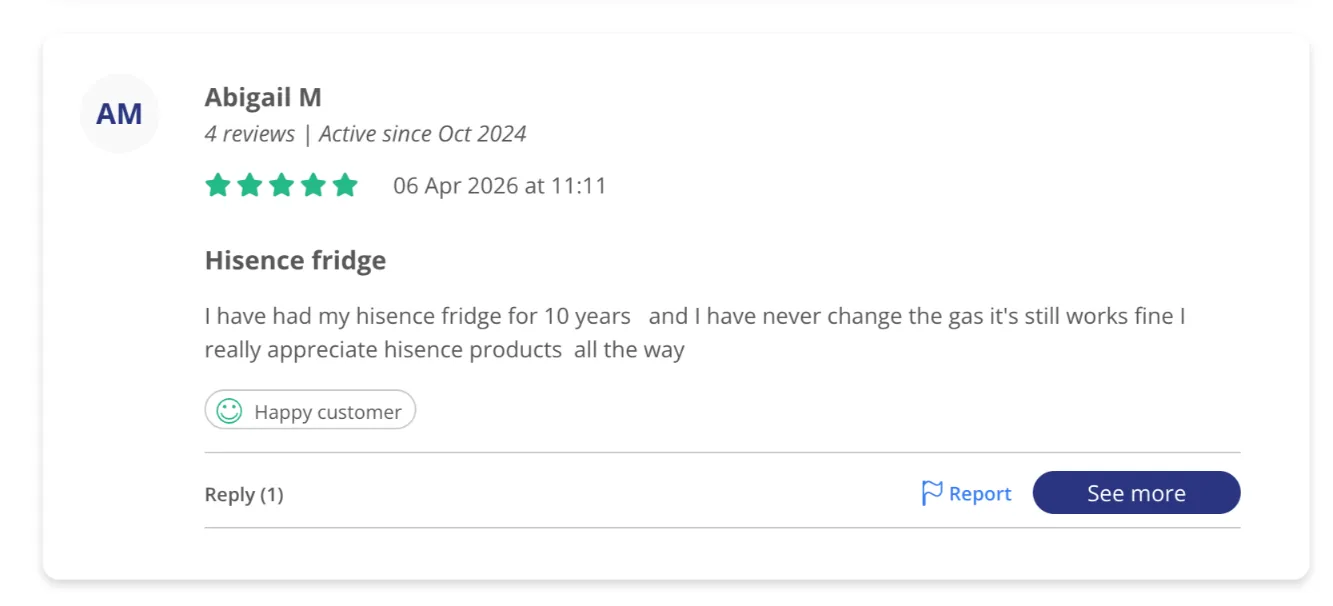
You can check out more reviews here.
Defy Appliances have good reviews with few negatives but not on refrigerators. so here is a review on their refrigerators:
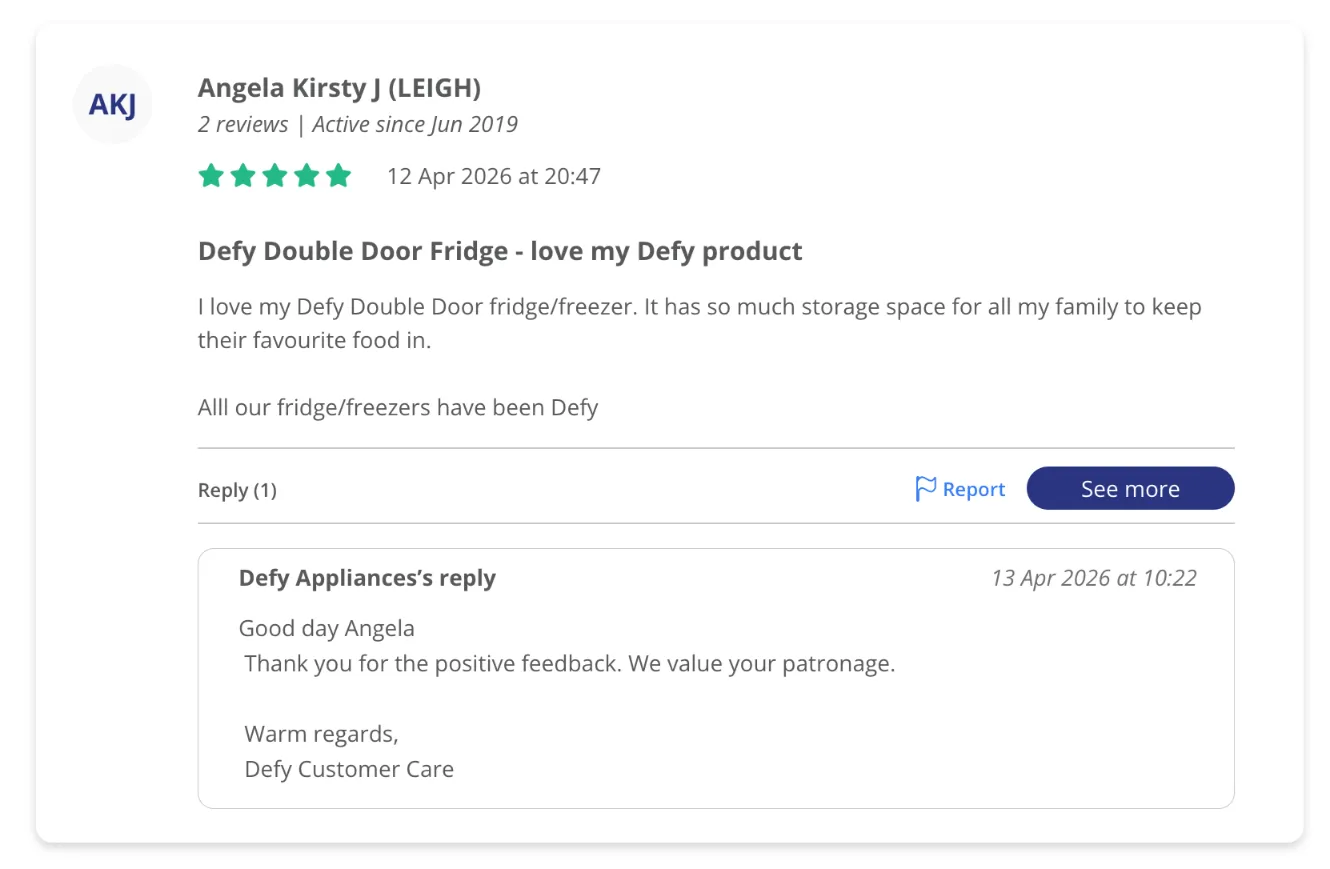
check more Defy reviews.
You can also check Samsung reviews on hellopeter.com.
b) Takealot.com
This is South Africa’s biggest online store where every fridge listing has real customer reviews from SA buyers (photos, ratings, pros/cons).
What you do is search “fridge” or a brand/model on Takealot and read the “Customer Reviews” section. A plus with takealot.com is that you can see all the details, including the price.
Below are links to some fridges I checked out. I provided a screenshot of where to click to see reviews. Take a look:
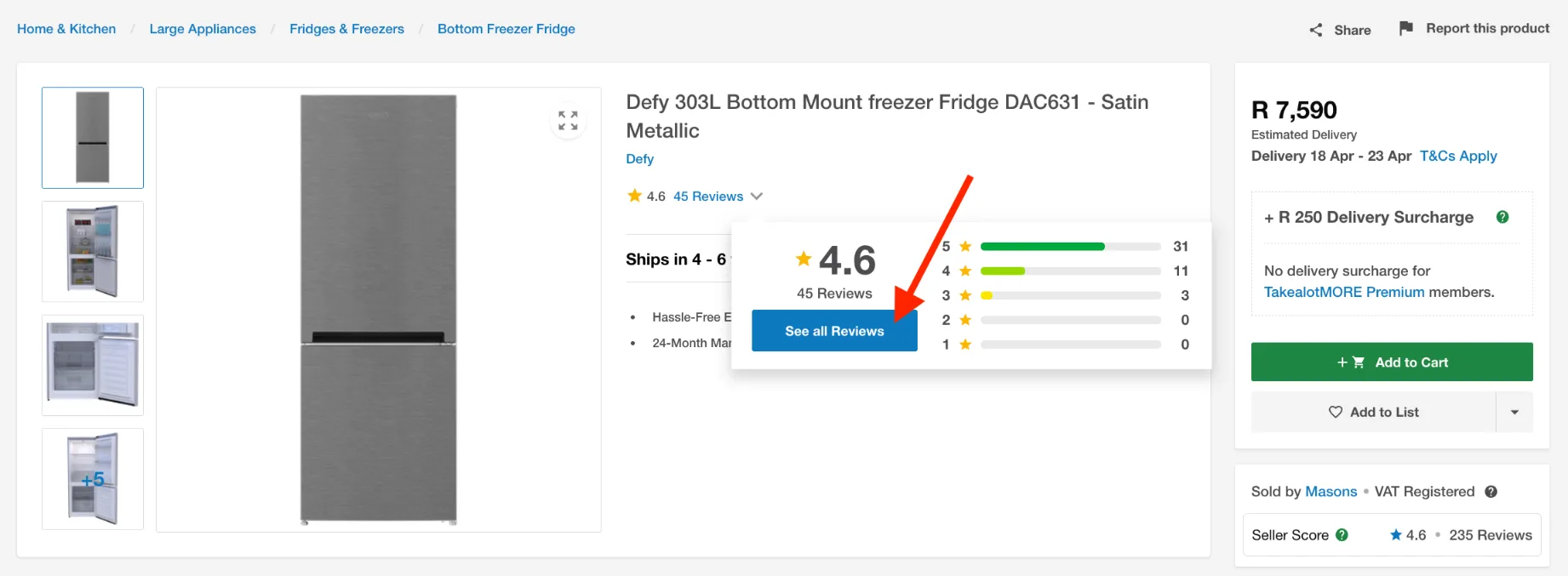
- Defy fridge customer review.
- Hisense fridge review.
c) Reddit
When I was looking through Reddit reviews, I came across several. Customers were also recommending brands that have not been discussed in the above list. The recommendations include brands like Smeg and Siemens.
Check them out:
- Recent fridge recommendations thread.
- Another solid thread.
d) MyBroadband Forum
Then I came across my broadband forum. It has threads with user experiences from across the country.
So people ask questions and maybe get advice on what fridge to go for, then get answers from others who have already bought fridges and have feedback to give.
- Fridge recommendations, check them out.
- Here is a 2014 but useful brand comparison.
Choose Your Go-To Brand
At this point, you have enough information on fridge power consumption and can now choose one confidently. Leave a comment for me and for others on what brand you would go for and why. If you already have experience, let us know how your experience has been. Happy shopping, friend.
Read also: